




Beyond Customer Service Training

Vision and insights about guest experience in aviation.

Vision and insights about guest experience in aviation.

Welcome to Thoughts from YATES+, developed by the leaders and subject matter experts from YATES+. We wish to share insights and vision about guest experience for airlines and lounges. For today, and the future.

Welcome to Thoughts from YATES+, developed by the leaders and subject matter experts from YATES+. We wish to share insights and vision about guest experience for airlines and lounges. For today, and the future.

Welcome to Thoughts from YATES+, developed by the leaders and subject matter experts from YATES+. We wish to share insights and vision about guest experience for airlines and lounges. For today, and the future.

Welcome to Thoughts from YATES+, developed by the leaders and subject matter experts from YATES+. We wish to share insights and vision about guest experience for airlines and lounges. For today, and the future.

Beyond Customer Service Training

Caviar, Vintage Champagne & the New Language of Luxury Dining at 35,000 Feet
A Holistic Approach to Elevating the Patient Experience

4

mins

mins

mins

mins

mins

mins

mins

min

mins

mins

mins

mins

mins

min

mins

mins

mins

mins

mins

read

By

Pam Poranan

Assoc. Prof Dr. Maxwell Winchester

February 10, 2025

What’s a Rich Text element?

The rich text element allows you to create and format headings, paragraphs, blockquotes, images, and video all in one place instead of having to add and format them individually. Just double-click and easily create content.

Static and dynamic content editing

A rich text element can be used with static or dynamic content. For static content, just drop it into any page and begin editing. For dynamic content, add a rich text field to any collection and then connect a rich text element to that field in the settings panel. Voila!

How to customize formatting for each rich text

Headings, paragraphs, blockquotes, figures, images, and figure captions can all be styled after a class is added to the rich text element using the "When inside of" nested selector system.

The value of patient experience to the healthcare industry is immeasurable, yet health care facilities are often left in the dark when it comes to its effective measurement and consequent improvement.

In recent years, countries such as Britain and the United States have attempted to assess patient experience within health and hospital services on a broad scale.

However, the generic and quantitative nature of these assessments have resulted in hospitals and healthcare facilities being presented with unactionable data in terms of their own specific contexts.

To address this issue, YATES+ has launched the World Class Patient Experience (PX) Pulse: an exclusive measurement tool that helps health care facilities achieve world class patient experience.

The World Class PX Pulse is an auditing system that uses healthcare/hospitality professionals to identify what matters most to patients, offering health care facilities actionable data and the opportunity to focus on areas that need improvement.


Read more about the World Class PX Pulse here

Lounge experiences are commonly a guest’s first impression of an airline or airport, yet studies reflect significant guest dissatisfaction with lounge standards globally.

The APEX World Class Lounge by YATES+ award,  has been engineered to identify key elements of the airport lounge experience that matter most to guests.

By triangulating objective measures of lounge service quality alongside qualitative feedback, the APEX World Class Lounge Audit creates a well-rounded review of elements needing to be addressed in alignment with world class standards.

The APEX World Class Lounge by YATES+ award gives recognition to airport lounges of exceptional guest experience on a global level.


To learn more, continue reading here.

Icon of the interim between check-in and boarding, lounges aren’t to be underestimated in terms of influencing the overall guest experience. Understanding what is important to travellers in lounges is crucial.

YATES+ has identified four key constructs and nineteen dimensions through which to evaluate lounge guest experiences.

Building on this evaluation methodology, the APEX World Class Lounge by Yates+ audit was designed in 2024 to recognise exceptional lounges of World Class standard.

If you believe that your lounge reaches these standards, we invite you to participate in the audit and gain the recognition you deserve.  


Access the full article here.

Caring for patients is at the heart of healthcare, yet the patient experience does not always reflect this intent.

Drawing on a decade of experience as a patient experience leader in the Middle East, Pam Poranan shares her expertise in elevating the patient experience.

She reflects on the common practice of combating patient dissatisfaction with staff training and reveals why this is often ineffective.

Her crucial insight into hospital operations and organisational culture highlights a deep understanding of how to transform the patient experience from the inside.


Access the full article here.

What’s a Rich Text element?

The rich text element allows you to create and format headings, paragraphs, blockquotes, images, and video all in one place instead of having to add and format them individually. Just double-click and easily create content.

Static and dynamic content editing

A rich text element can be used with static or dynamic content. For static content, just drop it into any page and begin editing. For dynamic content, add a rich text field to any collection and then connect a rich text element to that field in the settings panel. Voila!

How to customize formatting for each rich text

Headings, paragraphs, blockquotes, figures, images, and figure captions can all be styled after a class is added to the rich text element using the "When inside of" nested selector system.

During my 10 years of healthcare experience 
in the Middle East, one of the most common questions posed by hospital leadership was, 'Do our staff need more customer service training?’

These conversations were triggered by patient complaints or leadership observations of service issues, which were typically followed by a training request. This request stemmed from the belief that patient experience is  enhanced through customer service training. It was clear that there were good intentions and commitment from healthcare leadership to enhance patient experience.

However, it is crucial for healthcare leaders to discern whether training is the right solution to enhance patient experience, or if training alone is not enough to achieve their goals. In many cases, a broader transformation, a systemic change, is required to make a significant positive impact to patient experience1.

Staff appearing unwelcoming, showing a lack of empathy to patients2 or communicating poorly, are the most cited patient experience challenges for hospitals and medical facilities3 Another common challenge is long waiting times at medical facilities4 When patients raised complaints, they are likely to be addressed superficially, placating patients with the aim of resolving the complaint as quickly as possible, rather than looking for root causes or implementing systemic changes.5

The complaint handling procedure becomes a cosmetic solution masking the underlying issue. Training staff in the skills to manage complaints may seem to be an obvious solution, however, this on its own does not help with improving the overall patient experience.

Two forces sit at the centre of this transformation:

  • Intense pressure on airline CEOs  to deliver consistently high Net Promoter Scores (NPS)
  • Rapid advances in digital and AI capabilities

These  forces are reshaping the end‑to‑end journey.

Why NPS Suddenly Matters So Much


While NPS is a valuable easy to implement aviation industry standard it is fragile because it is sensitive to small changes and it lacks specificity as it focuses on “what” without insight to the ”why”. It is best used in combination with qualative feedback. See Beyond NPS: Why Airlines Need to Triangulate to Truly Understand The Guest Experience for further development of this point.

What cannot be denied is there has been a wide spread application of NPS in recent times among airlines.

Historically, airlines focused on classic operational metrics: load factor, on‑time performance, yield. Today, inspite of the limitations and non specific nature of NPS many boards and CEOs track NPS with equal intensity, for three reasons:

  • Loyalty economics: Promoters (NPS term)are believed to book more frequently, choose ancillary options (bags, seats, upgrades) and are more likely to join and engage with loyalty programs.
  • Digital transparency: Social media and review platforms mean a poor experience damages the brand immediately and visibly. NPS provides an early warning system.
  • Partner expectations: Alliances, corporate clients and even airports are using NPS as a shorthand for service quality and reliability.

As NPS becomes a board‑level KPI, airlines are re‑engineering the entire customer journey. Transformation of the Guest Experience, embracing the emotionally attractive opportunity, underlying personalisation, and elevating hospitality, is the vogue language of the moment.

Biometrics and touchless processing

Airports are becoming testbeds for biometrics and automation, often in partnership with airlines:

  • Face‑as‑boarding‑pass: Biometric verification at check‑in, bag drop, security and boarding can dramatically speed queues and reduce document checks.
  • Automated bag drops and tagging: Self‑service bag drops and smart bag tags reduce lines and give passengers more control over their time.

Passengers are frustrated by queues that move slowly for no visible cause; when they can use digital options and or biometric channels  satisfaction rises even if total time is not dramatically shorter. Immigration that can be whizzed through in minutes rather than hours is a definite must have for any modern airport.

In‑Flight: From One‑Size‑Fits‑All to Personalised Micro‑Journeys

Personalised content and connectivity

Onboard, digital innovation is changing what “good service” means:

  • IFE personalisation: Recommended movies, music and content based on prior selections and profile data, much like streaming platforms.
  • Connected cabins: Reliable Wi‑Fi enables messaging, live sports and productivity. For some segments (business travelers, younger leisure travelers), usable connectivity is now one of the drivers of NPS.

Service delivery and crew empowerment

AI is influencing how crew deliver hospitality:

  • Digital crew tablets: Provide a full view of the passenger manifest, including frequent‑flyer status, special occasions, preferences and service recovery opportunities (“this customer had a disruption yesterday; offer a gesture of goodwill”).
  • Service sequencing: Algorithms suggest optimal sequences for meal service, duty‑free, and special requests given load, flight time and passenger mix.

This converts crew from generic service providers into empowered hosts, which guests notice.

Digital and NPS as a real operational tool

Digital platforms connect NPS and other feedback directly to operations:

  • Journey‑level analytics: Instead of a single NPS per airline, data can be segmented by route, cabin, aircraft type, time of day, disruption status and more. This lets leaders investigate  which moments are potentially affecting loyalty.
  • Tangible Results: Importantly, Cabin Managers in a number of airlines can get to see how much value their on board leadership actually delivered through digital tools assessing customer satisfaction by individual flights.

As analytics mature, many airlines are tying frontline incentives and leadership scorecards directly to NPS and audit data, ensuring it shapes decisions rather than being a vanity metric.

The pace of transformation of the guest experience is accelerating and separating airlines.

Digital and AI tools are making personalisation possible beyond all belief.

Transforming mindset and engagement is the new horizon for Airline CEOs wishing to achieve top NPS and audit  results.

The icons remain — caviar and Vintage Champagne still reign supreme — but the essence of luxury is shifting. Today’s indulgence is measured in craftsmanship, balance, and sensory precision.

Few experiences capture the essence of indulgence like the caviar and Champagne ritual — timeless, deliberate, and unapologetically elegant. The weight of the crystal, the chill of the roe, the soft hiss as a cork releases at altitude — these gestures remain the heart beat of First Class dining. They are not trends; they are traditions, preserved precisely because they still move us.

Yet even the most iconic rituals are being refined. The future of inflight dining is not about replacing what works — it’s about rediscovering why it matters. Luxury is evolving into a quieter, more curated expression of indulgence, one that celebrates provenance, intention, and calm precision.


Across Asia, the Middle East, and Europe, the new definition of indulgence centres on refinement rather than extravagance. The focus is shifting from abundance to artistry: smaller portions, seasonal ingredients, and a balance between richness and restraint. Champagne remains the benchmark — now more selective, with curated vintages and prestige cuvées chosen for depth, freshness, and character at altitude. Its supporting cast, meanwhile, is evolving. Light aperitifs, botanical tonics, and elegantly layered zero-proof creations now complement the menu without diminishing its prestige. These additions reflect a modern luxury that values clarity, wellness, and craftsmanship.

Menus themselves are becoming more deliberate and sensory. Caviar remains the star, but it may arrive with subtle accompaniments: smoked salt, micro-herbs, or warm blinis made to order. Truffle, lobster, and heirloom vegetables appear in compact, perfectly executed dishes. Presentation mirrors the finest restaurants —bone China, crisp linen, hand-blown glass — yet pared back to feel calm, not crowded.

This is mindful hedonism:

indulgence that restores rather than overwhelms. It’s less about opulence and more about orchestration — where every element has purpose and poise.

First Class dining will never lose its icons — it will refine them. Caviar and vintage Champagne remain the emblems of success and celebration, but they now sit within a broader philosophy of balance, wellbeing, and craftsmanship. The experience is still indulgent, but its language has changed: quieter, smarter, and infinitely more personal.

The new luxury isn’t louder — it’s smarter, calmer, and designed for those who understand restraint.
There are conversations that confirm what you already believe, and there are conversations that quietly shift something in your thinking. My recent podcast with Keith Yates, Chair of Yates and Partners, was very much the latter.
Keith and I have known each other for roughly thirty years, going back to our Shangri-La days in the late eighties and early nineties. We worked together more recently at Hotel ICON in Hong Kong, where we spent considerable time breaking down the entire customer journey and rebuilding it with far greater intention. That project still holds up today, which tells you something about the durability of what Keith and his team do.

​Sitting down with him for this conversation reminded me how much genuine thinking goes into the work that most people in this industry take for granted.

The Business of Elevation

Yates and Partners operates in two areas.

The first is the transformation of the guest experience, working with hotels and airlines to take what is already functioning well and elevate it into something that leaves a lasting impression. The second is airport lounge design, conceived and delivered with the same philosophy. ​

Keith is clear about what transformation actually means. It is not about cosmetic changes or reordered menus. It is about identifying the emotion that should define an experience and then building everything around it. ​

He describes this as the hospitality mindset, and it requires total organisational buy-in. You cannot start on the front line. If the leadership group has not absorbed the thinking first, the change will not hold. ​

It is a point I have seen proven time and again in my own career. The hotels and airlines that sustain genuine service excellence are those where the CEO and the head offinance understand the brand experience as deeply as the people delivering it. ​

What struck me most in our conversation was how consistent this has been throughout his thirty years of practice. The principles have not changed. What has changed is the complexity of the environments in which he applies them.

Technology as a Tool, Not a Shortcut

We spent a good portion of our conversation on technology, and it is where Keith is perhaps most energised right now.

He described airports that have already approved AI-driven camera systems capable of identifying a guest as they walk through what he calls a contactless corridor, from the kerb to the aircraft door, without needing to present a passport or boarding pass. In the lounge context, a host will already know who is arriving before they step inside. The greeting becomes personal from the very first moment, not scripted, but genuinely informed and warm. ​

What matters is how Keith frames this. He is not excited about the technology for its own sake. He is interested in how it removes the transactional friction that interrupts a guest’s emotional experience.

Every moment where someone has to stop, fill in aform, or produce a document is a moment where hospitality is paused. Remove those moments and the service can flow naturally.

​I have long believed that airlines tend to pioneer these initiatives before hotels catch up, and Keith agreed. He attributes this to the intensity of competition in aviation and the rigour of ranking systems. Skytrax and the APEX World Class audit are structured, demanding, and measurable. Airlines are assessed across multiple dimensions, with NPS data aligned to performance outcomes. There is accountability, and there are real revenue implications. ​

Hotels, by contrast, can position themselves as five-star with far less scrutiny.

The Art of Reading the Room

One of the most valuable parts of our discussion was around personalisation and what truly seperates an outstanding team member from an average one.

Keith put it simply.

The greatest skill is not remembering a guest’s name or their seat preference. It is the ability to stand in front of someone and ask, honestly, how do I personalise this moment? ​

That answer changes with every guest. Some want privacy. Some want engagement. Some arrive carrying the weight of a difficult day and need to feel that things are about to improve. ​

The ability to read that accurately and respond accordingly, rather than relying on a script, is what Keith describes as understanding the moment. It can be developed, but only in individuals who already possess a certain level of emotional intelligence. This is why recruitment must begin with the brand experience. You define what the service should feel like, then select people capable of delivering it.

A Question About Asian Excellence

I asked Keith some thing I have considered for years. Why do the top airlines in the world consistently come from Asia?

His answer was immediate. It comes down to values shaped through upbringing and environment, where placing the guest first is instinctive.

It is not about subservience. It is about prioritising another person’s comfort without ego or resistance. ​

That mindset is difficult to instil if it is not already present. ​

Having lived and worked across Asia for decades, I have seen this firsthand. Returning to the UK, the contrast is noticeable. You occasionally experience it in family-run establishments where the warmth is genuine, but it is not widespread. ​

Keith has found ways to work effectively with European teams, building on what he calls European flair and fostering pride in that identity. At the same time, he is realistic about the cultural differences and what they mean for consistently delivering world-class service.

Where the Industry Is Heading

Keith closed with an observation that feels accurate.

The hotel sector is splitting into two paths. Large brands are building what they market as luxury, but in reality, it is accessible luxury, designed for a broader audience. At the same time, a smaller group of operators remain committed to true luxury, whichis inherently personal. ​

You cannot deliver genuine luxury without human connection. It requires people who know the guest and respond to them as individuals.

​The challenge is that some brands are trying to deliver accessible luxury while reducing the very staff who make it meaningful. That is a contradiction that will be difficult to sustain.

Key Takeaways

This conversation reinforced several beliefs shaped over a long career in international hospitality. ​

Transformation is not decoration. Leadership alignment must come before frontline training. Technology should remove friction, not replace human connection. And the defining quality of exceptional service is the ability to read a person and respond to them as an individual. ​

Keith Yates has spent thirty years demonstrating that these principles work. This conversation was a timely reminder of why they still matter.

Yet executives keep asking the exact same question:

“Why doesn’t the behaviour change last?”

Training rarely fails in the classroom. It fails in the everyday operational system people return to.

More than three decades ago, researchers Mary Broad and John Newstrom introduced 'Transfer of Learning'—the extent to which people apply training to their jobs.Their data unearths a harsh commercial reality:

  • 40% of skills fail to stick immediately after training.
  • 85% of investment is lost after one year as people default to old habits.

The primary culprit? A lack of leadership reinforcement.

The most influential person in a training programme may never enter the classroom.

In fast-paced, high-stress industries like aviation or hospitality, this gap is brutal. On the shop floor or in the air, employee behaviour is not driven by manuals. It is driven by the mindsets, priorities, and subtle signals reinforced by managers daily.

Too often, corporate training is deployed defensively as an administrative “quick fix” to systemic problems. Leaders expect a three-day workshop to magically repair behaviours without changing the operational pressures that created them.

Once the programme ends, real-world fires return. New learning is left to fight a losing battle against an environment designed to crush it.

At YATES+, we see this constantly: training failure is rarely due to a lack of employee capability. It is undone because managers dilute learning by skipping follow-ups, failing to role-model behaviours, or quietly pressuring teams to hit immediate numbers.

Building a Leadership System

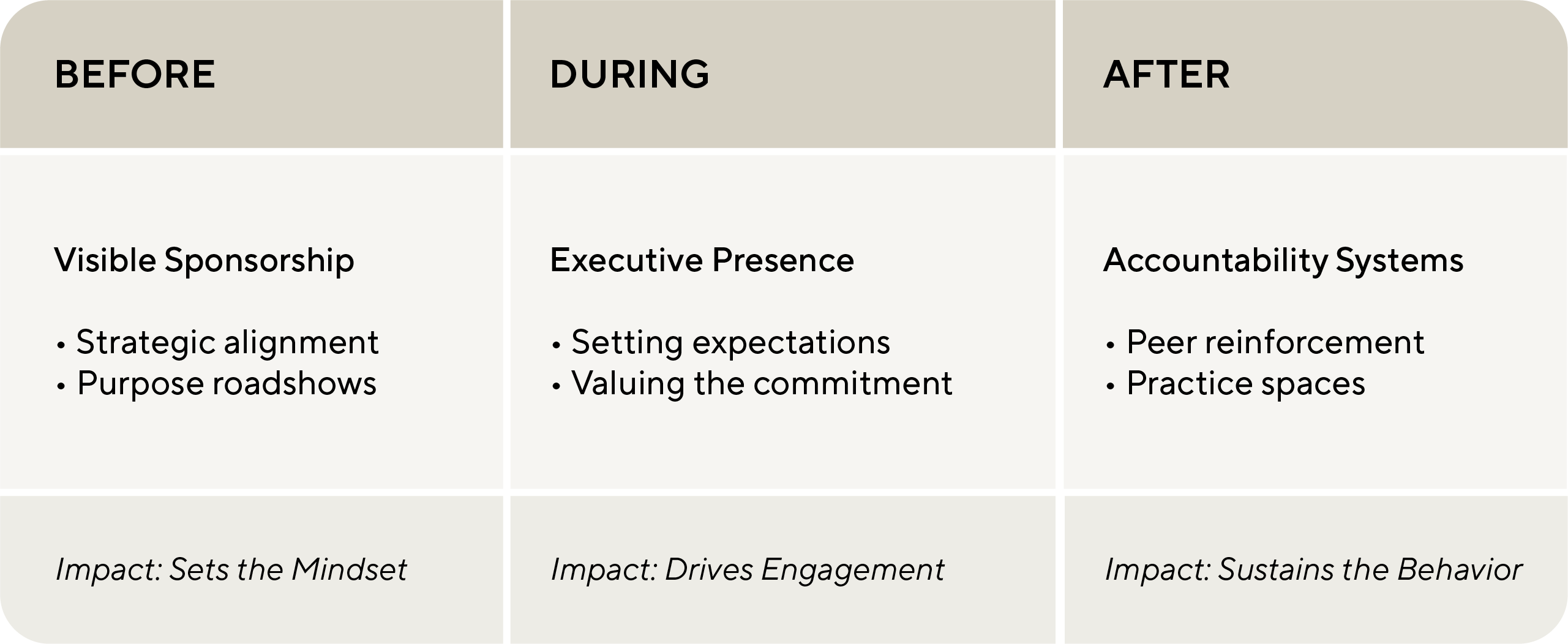
Organisations achieving lasting transformation recognise that learning transfer is a leadership responsibility, not an L&D KPI. They divide leadership intervention into three deliberate phases:

  • Before: Visible Sponsorship
    ​Senior executives visibly sponsor the initiative as a strategic priority. They use roadshows to align teams on purpose, outline what success looks like, and establish that value is measured by application, not classroom attendance.
  • During: Executive Presence
    ​Leaders maintain a physical presence by stepping into the classroom. They welcome participants, connect content to the long-term corporate vision, and elevate the programme from an activity to a core commitment.
  • After: Architecture of Retention
    Teams build intentional accountability structures. They create communities of practice, peer networks, and safe "back-to-work" rehearsal challenges. Leaders coach, provide feedback, and recognize progress until new behaviours become permanent habits.

Moving Beyond Training


In high-consequence service environments, professionals rarely need more instruction. They need permission and reinforcement to execute what they already know.

Training maps out the arena of possibility; leadership behaviour determines whether that possibility turns into a tangible business result. True transformation does not happen when the facilitator closes their laptop. It happens when learning is systematically protected, practiced, and sustained in the daily rhythm of work.

Join the conversation on Linkedin:

What is the biggest operational roadblock you have faced when trying to make new training stick within your teams? Let's discuss on LinkedIn

Source:

Broad, M.L. & Newstrom, J.W. (1992). Transfer of Training: Action-Packed Strategies to Ensure High Payoff from Training Investments.

There are conversations that confirm what you already suspected, and then there are conversations that sharpen your thinking in ways you did not quite expect. My recent podcast discussion with Janis Tse fell firmly into the second category.
Janis leads Lounge by YATES+, the guest experience consultancy arm of Yates+Partners, founded by Keith Yates, one of the most respected and quietly visionary figures in the guest experience world. Keith appeared on an earlier episode of this podcast and planted several ideas that I found myself still thinking about weeks later.

Janis carries that same depth of thinking. She has spent the better part of 20 years working across aviation, hospitality, and brand strategy in over 30 countries, and Keith has been both a professional anchor and a genuine mentor to her along the way. She is someone who thinks deeply about spaces that most people pass through without much thought. And that, I found, is exactly the point.

The Business of Elevation

I have been using airline lounges for most of my working life. Forty years in Asia gave me a fairly clear picture of how these spaces evolved, and also of where they consistently fell short. The best way I could put it to Janis was this: many lounges have been designed the wrong way around. Architecture and aesthetics come first. Guest experience follows later, often as an afterthought.

She did not hesitate. She had seen it too many times.

The pattern she described is familiar to anyone who has worked in large organisations. A project team commissions an interior designer. The operations team comes in at the end. The food and beverage function sits somewhere in the middle, often disconnected from both.

Everyone is working in silos, and by the time the lounge opens, the fundamental question of how a guest actually moves through the space and what they genuinely need has never been properly answered.

What struck me about Janis's perspective was that this is not simply a design philosophy argument. It is a commercial one. A lounge where the buffet sits in the centre of the room pulls all foot traffic into one spot, creates congestion, and makes the rest of the space feel redundant. That is not a minor inconvenience. That is a failure of planning that costs money and costs guests.

Technology as a Tool, Not a Shortcut

One of the most useful frameworks Janis shared was the idea that F&B should be the starting point for any lounge design, not an element to be fitted around the furniture. This might sound obvious, but in practice, it rarely happens that way.

Her argument is straightforward. A buffet no longer differentiates a lounge. Airport food courts have improved dramatically. Retail and dining options in major terminals are genuinely competitive. If a lounge cannot offer something that feels considered and personal, the traveller has better alternatives.

What she advocates for is a set of distinct F&B concepts spread across the space, each serving a different type of guest. The solo business traveller who needs a quick glass of champagne and a working surface. The family with children who need something entirely different. The passenger with two hours to spare before a long-haul flight versus the one who wants to grab and go in 30 minutes. When you design around those actual human needs, the space organises itself more sensibly. Traffic flows better. Waste reduces. The experience becomes more personal.

The comparison that came to mind for me was the work that Super Potato did in Japan, and later the theatre kitchen concept that Shangri-La borrowed and adapted at their Singapore property. That idea of visible, live cooking, food made in front of you and to your order, is exactly the kind of thinking lounges have been slow to adopt. Janis agrees it is where things are heading.

The Art of Reading the Room

There is a financial reality underneath all of this that does not get discussed enough in polite industry conversation. An airline lounge is, for most carriers, a cost centre. ​

An independent lounge like Plaza Premium is a profit centre. Those two models require entirely different thinking, and yet they are increasingly expected to offer comparable experiences.

Janis made the case clearly. The airline lounge should be treated as a strategic business asset, not a budget line to be minimised. When planned properly, it contributes to loyalty, to revenue through upselling and tiered access, and to the kind of brand advocacy that no marketing spend can fully replicate. ​

The three to five year return on investment horizon for a well-designed lounge is real. But it requires the C-suite to think about it that way from the outset.​

The question of paid access is nuanced. Janis is not against it, but she is precise about how it should be managed. Open the lounge too widely and you dilute the experience for the passengers who matter most to the brand. The answer, she believes, is smart zoning: a single space that uses design and flow to create distinct environments for different tiers of guest, rather than a single undifferentiated room where everyone competes for the same seats.

It reminded me of something we worked through at Hotel Icon in Hong Kong, where the top floor lounge had to function as a breakfast space, a daytime working and dining area, and an evening cocktail lounge, all within the same footprint. Terence Conran's team solved it through intelligent zoning and a flexible design brief. The principle is identical.

A Question About Asian Excellence

On the subject of technology, Janis was measured in a way I found refreshing. There is a tendency in the industry to treat technology as the answer before the question has been properly asked. She does not see it that way.​

The question she returns to is this: how do we make each guest feel genuinely heard, calm, and cared for? Technology can support that. It can enable staff to know a returning guest's preferences before they sit down. It can improve operational efficiency behind the scenes. But it cannot replace the moment when a member of staff notices that a guest looks stressed and decides to do something about it. ​

She told a story from her own experience, travelling through Doha and losing a flask she cared about, arriving at the lounge tired and visibly deflated. The staff member who sat her down, took her details, and came back with a genuine effort to help did not find the flask. But the effect was immediate. She felt listened to. She felt less alone in the stress of travel. That, she said, is what a great lounge does that no technology can fully replicate. 

I believe that. I have seen it in hotels for 40 years. The moments that guests remember are rarely the ones planned in advance.

Where the Industry Is Heading

I put a question to Janis that I already had a sense of the answer to, but wanted to hear her articulate. Why do Asian airlines and lounges consistently lead in global rankings? Why do Singapore Airlines, Cathay Pacific, and Japan Airlines keep winning?

Her answer was direct. It is the mindset. Not the systems, not the checklists, not even the training programmes. The underlying cultural orientation toward making the person in front of you feel genuinely looked after is what separates great hospitality from competent service. You can document it and teach around it, but you cannot manufacture it without working on how people think about their role.​

This is something Yates+Partners works on at the leadership level. The belief is that meaningful change in guest experience starts with the mindset of the CEO and flows downward. Get the thinking right at the top, and the procedures follow naturally. Try to impose procedures without the thinking, and they become hollow. ​

I have seen this play out in hotels repeatedly. The properties that deliver genuinely excellent guest experience are almost always led by people who care about it personally, not just commercially

Where the Industry Is Heading

No serious industry conversation today avoids sustainability, but too many of them end up in the territory of aspiration without substance. Janis kept things practical. ​

She made the case for removing plastic entirely from lounge operations, starting with bottle-free water stations, which she uses personally when she travels. She made the case for on-demand cooking over buffets, which reduces food waste significantly and improves the guest experience at the same time. And she pointed to the Pearl Lounge in Bahrain, a project her team designed from scratch, as an example of how natural light and shared terminal cooling systems can reduce energy consumption in meaningful ways without compromising the guest environment. ​

The Pearl Lounge is now ranked among the top three in the world by APEX. That outcome is not in spite of its sustainable design. It is partly because of it.​

We touched briefly on uniforms, which is an area I spent some time on at Hotel Icon. Working with Crestwell, we switched to sustainable fabrics made from materials including maize and bamboo. They were breathable, well-made, and the staff wore them with a sense of pride precisely because of what the choice represented. There is a culture signal in that kind of decision. When the team sees that leadership is serious about sustainability in the smallest details, it changes how they think about the larger ones.

Where the Industry Is Heading

One of the moments near the end of our conversation that stayed with me was when Janis mentioned that she had been invited back to guest lecture MBA students at the School of Hotel and Tourism Management at PolyU in Hong Kong. She spoke about it with real warmth. ​

It matters. The people who will be designing and running lounges in ten years are sitting in those classrooms now. ​

What they hear from practitioners, people who have actually done the work across different markets and cultures, shapes how they think about the problems they will eventually face. 

​Janis has that kind of experience. She is not speaking in abstractions. She is drawing on 20 years of decisions made in real rooms, with real budgets, for real brands. That is what students need to hear.

Where the Industry Is Heading

There was one area I wanted to explore that sits slightly outside the usual industry conversation, and it is the one that I think will resonate most with anyone who has ever stepped off a long flight and walked into a lounge feeling completely spent.​

Travel is stressful. It has always been stressful and, regardless of how much the industry improves, it will remain so to some degree. The documents, the packing, the queues, the security process, the noise, the waiting, the uncertainty around delays and cancellations, and the fundamental vulnerability of being somewhere between where you were and where you are trying to get to. None of that disappears when you walk through a lounge door. 

I asked Janis directly: can a lounge genuinely make someone feel the way great hospitality does, calm, known, and at ease, or is travel stress simply unavoidable no matter how well-designed the space is?

Her answer was honest and personal. Travel is stressful, she said. She did not try to argue otherwise. But she was equally clear that a lounge can make a real difference to how a person moves through that stress, and the difference is not found in the furniture or the food offering. It is found in whether the person at the door sees you as an individual rather than as the next arrival.

She returned to the story of losing her flask in Doha, arriving at the lounge feeling deflated and a little defeated. What changed the moment was not a particularly impressive space. It was a member of staff who noticed she was not alright, sat her down, took her seriously, and did something about it. The flask was not recovered. But she left that interaction feeling calmer and less alone in her frustration. 

That is the gap that great hospitality fills. Not the removal of stress, but the reduction of isolation within it. In a hotel, a great concierge does the same thing. A genuinely attentive waiter does the same thing. The skill is identical, the context is just more pressured in an airport.

What this means in practice is that the emotional reality of the traveller has to be built into the brief from the start. Not as a nice sentiment, but as a design constraint. How does a guest feel when they arrive? What are they carrying emotionally, not just physically? What does calm look like for a solo business traveller at six in the morning versus a family with young children at midday? If those questions are not being asked before the architects begin their drawings, the answers will not appear in the finished space.​

Janis believes the best lounges are beginning to understand this. The ones that are genuinely leading are not simply the most beautiful or the most lavish. They are the ones where the staff have been trained and trusted to respond to the person in front of them, to use their judgement, and to make the guest feel that for this moment, in this room, someone is paying attention.​

That is what great hospitality has always been. The lounge, at its best, is simply the latest space to learn it.

Key Takeaways

The lounge has become one of the most contested pieces of real estate in the travel industry. More operators, more passengers, more expectations, tighter space, and growing commercial pressure from every direction. Navigating that well requires a kind of thinking that is genuinely rare: the ability to hold the commercial, the operational, the experiential, and the human all at once.

Janis Tse does that. She thinks about the guest in the room, the chef behind the counter, the CFO reading the P&L, and the architect at the drawing board, and she understands how each of those perspectives has to be brought into conversation with the others before anything meaningful gets built.

The lounge is not just a room you wait in. At its best, it is the place where travel stops feeling like something that is happening to you and starts feeling like something being done for you. That distinction, small as it might sound, is everything.

Data on its own will not improve patient experience, there has to actionable information available and there needs to be a commitment to take action (Ahmed, Burt & Roland, 2014).

In fact, Coulter et al (2014) raised concern that despite the NHS implementing a thorough programme of PX measurement in 2013, there was no system in place to ensure the data improved performance.  This concern was confirmed in a study of all 153 NHS trusts which showed the results of the NHS patient satisfaction studies in various constructs did not lead to improvements in performance (Locock et al, 2020).  Below is the summary of patient experience dimensions included in different studies.  

The standard ‘customer satisfaction (CX)  measurement systems’ in healthcare or to be precise  - ‘patient experience (PX) measurements’ do not provide actionable feedback on what or how things need to be improved, which has been highlighted as most desirable by healthcare facility managers(Barry et al, 2015; Coulter et al 2014). PX measures also do not provide the much-needed ability to benchmark against other health care providers (Barry et al, 2016). Patients are not experts on health care service delivery (Ahmed et al, 2014; Barry et al, 2016), many have different expectations, which biases the results (Ahmet et al 2014)and most will have few comparison points to make a judgement on patient experiences.

Customer Experience (CX)/Patient Experience (PX) measures also assume that measuring customer attitudes of service provision is a valid measure of the service provision on offer(rather than actually measuring the service provision) (Sharp, Page &Dawes, 2000).

Objective measures of service quality by industry professionals are rare in practice, with the exception of mystery shopping, which is considered a marketing research-based variant of participant observation (Sharp, Page & Dawes, 2000). Across industries, mystery shopping has been demonstrated to be reliable and valid as a measure of customer experience(Dawes, Sharp & Adelaide, 2000) and the dimensions that emerge from mystery shopping generally resemble SERVQUAL dimensions. More specifically, simulated patient studies, known as ‘pseudo-patients’ (Lazarus, 2009) have demonstrated robustness over other patient satisfaction measures that include reduced recall bias, social desirability bias and elimination of bias from demographic factors (Campbell et al, 2013; Goodrich & Lazenby, 2022) and should be part of a health facility’s PX improvement programme (Lazarus, 2009).  

Mystery shopping more broadly has been used extensively in health care scenarios (Jacob et al, 2018) and has been demonstrated in one clinical setting to increase net margins by over 14 percent within 18 months of implementation (O’Neill et al, 2012) and in others, it contributed to significant improvements in PX, along with improvements in employee satisfaction and engagement (Garantino et al, 2013; Daouk-Öyry, 2018).

References:

¹ Reichheld, F. F. (2003). The one number you need to grow. Harvard business review, 81 (12), 46-55.

² See:
• Dawes, J. G. (2024). The net promoter score: What should managers know?. International Journal of Market Research66 (2-3), 182-198.
• Keiningham, T. L., Cooil, B., Andreassen, T. W., & Aksoy, L. (2007). A longitudinal examination of net promoter and firm revenue growth. Journal of Marketing,71 (3), 39-51.

³ p. 53 Reichheld, F. F. (2003). The one number you need to grow. Harvard business review,81 (12), 46-55.

Most customer service training is carried out in isolation with a loose linkage to the new way of doing things. Enhancements in systems, processes, and policies must also happen when supporting staff with training. Training is useful for attitude and skills improvement if supported by the organisation’s culture – as in, ‘how we do things around here?’.

Essentially, a new destination or environment is required.

I frequently witnessed staff being taught proactive ways to offer help and assistance to patients and visitors during customer service training sessions. However, upon returning to their duties the staff were often powerless to carry out these directives due to restrictions placed on them by the existing environment. For example, being unable to offer a wheelchair to assist a patient due to a wheelchair shortage, or being unable to walk with visitors to guide them to the clinic as they were not permitted to leave the counter ‘unattended.’ Customer service training as a standalone tool is ineffective if there is no simultaneous systemic change.

Undoubtedly, the resources invested in training mostly lead to minimal or marginal beneficial improvement to the patient experience. Reflecting this is one study of the Advancing Communication Excellence program at a Northern Californian healthcare facility, revealing a $10,000 per participant investment made little difference to patient perceptions of care received6.

So, what can we do to enhance patient experience?

Based on my experience leading numerous patient experience (PX) transformation projects, 
there are three critical steps to making a tangible impact.

To take this further and to learn how the lounge audit is processed.
References:

¹ Cholkongka, N. (2019). Identification of service quality competency framework for the lounge attendants: a case of a privately-owned airline in Thailand. ABAC Journal 39(4) , 123-150.

² Nghiêm-Phú, B. (2017). An analysis of airline/airport lounge service using data gathered from airlinequality.com. Asia Pacfic Journal of Advanced Business and Social Studies, 4(1), 127-134

³ YATES+ have taken the decision to include sustainability and keeping guests safe as these are notable in the strategic plan of many airline, airport and lounge operators and have received a lot of attention in the wider media. A number of studies highlight the importance of cleanliness of lounges and lavatories which is an important part of the perception of “keeping me safe”.  The following studies also support the addition of “sustainability” as important in lounge and airport experiences:
• Abdel-Gayed, A. H., Hassan, T. H., Abdou, A. H., Abdelmoaty, M. A., Saleh, M. I., & Salem, A. E. (2023). Travelers’ Subjective Well-Being as an Environmental Practice: Do Airport Buildings’ Eco-Design, Brand Engagement, and Brand Experience Matter?. International Journal of Environmental Research and Public Health, 20(2), 938.
• Han, H., Lho, L. H., & Kim, H. C. (2019). Airport green environment and its influence on visitors’ psychological health and behaviors. Sustainability, 11(24), 7018

⁴ Cholkongka, N. (2019). Identification of service quality competency framework for the lounge attendants: a case of a privately-owned airline in Thailand. ABAC Journal, 39(4), 123-150.

⁵ Chua, B. L., Lee, S., Kim, H. C., & Han, H. (2017). Investigating the key drivers of traveler loyalty in the airport lounge setting. Asia Pacific Journal of Tourism Research, 22(6), 651-665.

⁶ Curkan, S. C., & Özkan, E. (2021). The effect of airline lounge services on the selection of airline. Journal of multidisciplinary academic tourism, 6(1), 17-26.

⁷ Han, S., Ham, S. S., Yang, I., & Baek, S. (2012). Passengers’ perceptions of airline lounges: Importance of attributes that determine usage and service quality measurement. Tourism Management, 33(5), 1103-1111.

⁸ Aditya Julio, S. E. Proposed service quality improvement using servqual method and importance performance analysis (ipa) of sultan executive lounge in sm badaruddin ii airport. Second International Conference on Theory and Practice (ICTP-2016), 28th and 29th, October, Melbourne, Australia
ISBN: 9780 9943 65613

⁹ Kim, Y. J., Ban, H. J., Kim, D. H., & Kim, H. S. (2020). Understanding customer experience of airline lounge using text mining of online review. Culinary Science & Hospitality Research, 26(2), 36-44.

¹⁰ Farris, P.W., Bendle, N., Pfeifer, P.E. & Reibstein, D.  (2010).  Marketing Metrics: The Definitive Guide to Measuring Marketing Performance.  Pearson: London

¹¹ Sharp, B., Page, N. and Dawes, J., 2000. A new approach to customer satisfaction, service quality and relationship quality research. Australian & NZ Marketing Academy Conference Proceedings, Griffith University.

¹²  See:
• Fisher, N. I., & Kordupleski, R. E. (2019). Good and bad market research: A critical review of Net Promoter Score. Applied Stochastic Models in Business and Industry, 35(1), 138-151.
• Keiningham, T. L., Cooil, B., Andreassen, T. W., & Aksoy, L. (2007). A longitudinal examination of net promoter and firm revenue growth. Journal of Marketing, 71(3), 39-51.);
• Kristensen, K., & Eskildsen, J. (2014). Is the NPS a trustworthy performance measure?. The TQM Journal, 26(2), 202-214.
• Mecredy, P., Wright, M. J., & Feetham, P. (2018). Are promoters valuable customers? An application of the net promoter scale to predict future customer spend. Australasian Marketing Journal, 26(1), 3-9.
• Romaniuk, J., Nguyen, C., & East, R. (2011). The accuracy of self-reported probabilities of giving recommendations. International Journal of Market Research, 53(4), 507-521.
• Pingitore, G., Morgan, N. A., Rego, L. L., Gigliotti, A., & Meyers, J. (2007). The Single-Question Trap. Marketing Research, 19(2).
• Sharp, B. (2006), “Net promoter score fails the test”, Marketing Research, Vol. 20No. 4, pp. 28-30.
Also see [https://customergauge.com/blog/airline-customer-experience-net-promoter-score] to see that according to this source Airlines such as Aeroflot, United Airlines and Thomas Cook score significantly higher than award winning airlines such as Singapore Airlines. Not surprisingly, this leads to industry experts to questioning the validity of the NPS.

¹³  Sharp, B., Page, N. and Dawes, J., 2000. A new approach to customer satisfaction, service quality and relationship quality research. Australian & NZ Marketing Academy Conference Proceedings, Griffith University.

¹⁴  Dawes, J., Sharp, B., & Adelaide, N. T. (2000). The reliability and validity of objective measures of customer service: Mystery Shopping. Australian Journal of Market Research, 8(1), 29-46.

¹⁵ Lowndes, M., & Dawes, J. (2001). Do distinct SERVQUAL dimensions emerge from mystery shopping data? A test of convergent validity. Canadian Journal of Program Evaluation, 16(2), 41-53.

¹⁶  Halvorsrud, R., Kvale, K., & Følstad, A. (2016). Improving service quality through customer journey analysis. Journal of service theory and practice, 26(6), 840-867.

References:

Agency for Healthcare Research and Quality (2023). [available: https://www.ahrq.gov/cahps/helpful-resources/index.html]. Accessed 19th February 2024.

Ahmed, F., Burt, J., & Roland, M. (2014). Measuring patient experience: concepts and methods. The Patient-Patient-Centered Outcomes Research, 7, 235-241.

Barry, H. E., Campbell, J. L., Asprey, A., & Richards, S. H. (2016). The use of patient experience survey data by out-of-hours primary care services: a qualitative interview study. BMJ Quality & Safety, 25(11), 851-859.

Campbell, J. L., Carter, M., Davey, A., Roberts, M. J., Elliott, M. N., & Roland, M. (2013). Accessing primary care: a simulated patient study. British Journal of General Practice, 63(608), e171-e176.

Coulter, A., Fitzpatrick, R., & Cornwell, J. (2009). Measures of patients' experience in hospital: purpose, methods and uses (pp. 7-9). London: King's Fund.

Coulter, A., Locock, L., Ziebland, S., & Calabrese, J. (2014). Collecting data on patient experience is not enough: they must be used to improve care. BMJ, 348.

Dawes, J., Sharp, B., & Adelaide, N. T. (2000). The reliability and validity of objective measures of customer service: Mystery shopping. Australian Journal of Market Research, 8(1), 29-46.

Daouk-Öyry, L., Alameddine, M., Hassan, N., Laham, L. & Soubra, M. (2018). The catalytic role of Mystery Patient tools in shaping patient experience: A method to facilitate value co-creation using action research. PLoS ONE, 13(10): 1-17 e0205262.
https://doi.org/10.1371/journal.pone.0205262

Granatino, R., Verkamp, J., & Stephen Parker, R. (2013). The use of secret shopping as a method of increasing engagement in the healthcare industry: A case study. International Journal of Healthcare Management, 6(2), 114-121.

Goodrich, G. W., & Lazenby, J. M. (2023). Elements of patient satisfaction: An integrative review. Nursing Open, 10(3), 1258-1269.

Jacob, S., Schiffino, N., & Biard, B. (2018). The mystery shopper: a tool to measure public service delivery?. International Review of Administrative Sciences, 84(1), 164-184.

Jenkinson, C., Coulter, A., Bruster, S., Richards, N., & Chandola, T. (2002). Patients’ experiences and satisfaction with health care: results of a questionnaire study of specific aspects of care. Quality and safety in health care, 11(4), 335-339.

Johansson, P., Oleni, M., & Fridlund, B. (2002). Patient satisfaction with nursing care in the context of health care: a literature study. Scandinavian journal of caring sciences, 16(4), 337-344.

LaVela, S. L., & Gallan, A. (2014). Evaluation and measurement of patient experience. Patient Experience Journal, 1(1), 28-36.

Lazarus, A. (2009). Improving psychiatric services through mystery shopping. Psychiatric services, 60 7, 972-3 .

Lee, W. I., & Lin, C. H. (2011). Consumer hierarchical value map modeling in the healthcare service industry. African Journal of Business Management, 5(3), 722.

Locock, L., Graham, C., King, J., Parkin, S., Chisholm, A., Montgomery, C., ... & Ziebland, S. (2020). Understanding how front-line staff use patient experience data for service improvement: an exploratory case study evaluation. Health Services and Delivery Research, 8(13).

Lowndes, M., & Dawes, J. (2001). Do distinct SERVQUAL dimensions emerge from mystery shopping data? A test of convergent validity. Canadian Journal of Program Evaluation, 16(2), 41-53.

O'Neill, S., Calderon, S., Casella, J., Wood, E., Carvelli-Sheehan, J., & Zeidel, M. L. (2012). Improving outpatient access and patient experiences in academic ambulatory care. Academic Medicine, 87(2), 194-199.

Sharp, B., Page, N. and Dawes, J., 2000. A new approach to customer satisfaction, service quality and relationship quality research. Australian & NZ Marketing Academy Conference Proceedings, Griffith University.

Related Article

Beyond Customer Service Training

Vision and insights about guest experience in aviation.

Vision and insights about guest experience in aviation.

Vision and insights about guest experience in aviation.

Welcome to Thoughts from YATES+, developed by the leaders and subject matter experts from YATES+.
We wish to share insights and vision about guest experience for airlines and lounges.
For today, and the future.

Welcome to Thoughts from YATES+, developed by the leaders and subject matter experts from YATES+.
We wish to share insights and vision about guest experience for airlines and lounges.
For today, and the future.

Welcome to Thoughts from YATES+, developed by the leaders and subject matter experts from YATES+.
We wish to share insights and vision about guest experience for airlines and lounges.
For today, and the future.

Welcome to Thoughts from YATES+, developed by the leaders and subject matter experts from YATES+.
We wish to share insights and vision about guest experience for airlines and lounges.
For today, and the future.

In this Article

Beyond Customer Service Training

Caviar, Vintage Champagne & the New Language of Luxury Dining at 35,000 Feet
A Holistic Approach to Elevating the Patient Experience
By

Pam Poranan

Assoc. Prof Dr. Maxwell Winchester

Pam Poranan
Assoc Prof Dr Maxwell Winchester

The value of patient experience to the healthcare industry is immeasurable, yet health care facilities are often left in the dark when it comes to its effective measurement and consequent improvement.

In recent years, countries such as Britain and the United States have attempted to assess patient experience within health and hospital services on a broad scale.

However, the generic and quantitative nature of these assessments have resulted in hospitals and healthcare facilities being presented with unactionable data in terms of their own specific contexts.

To address this issue, YATES+ has launched the World Class Patient Experience (PX) Pulse: an exclusive measurement tool that helps health care facilities achieve world class patient experience.

The World Class PX Pulse is an auditing system that uses healthcare/hospitality professionals to identify what matters most to patients, offering health care facilities actionable data and the opportunity to focus on areas that need improvement.


Read more about the World Class PX Pulse here

Lounge experiences are commonly a guest’s first impression of an airline or airport, yet studies reflect significant guest dissatisfaction with lounge standards globally.

The APEX World Class Lounge by YATES+ award,  has been engineered to identify key elements of the airport lounge experience that matter most to guests.

By triangulating objective measures of lounge service quality alongside qualitative feedback, the APEX World Class Lounge Audit creates a well-rounded review of elements needing to be addressed in alignment with world class standards.

The APEX World Class Lounge by YATES+ award gives recognition to airport lounges of exceptional guest experience on a global level.


To learn more, continue reading here.

Caring for patients is at the heart of healthcare, yet the patient experience does not always reflect this intent.

Drawing on a decade of experience as a patient experience leader in the Middle East, Pam Poranan shares her expertise in elevating the patient experience.

She reflects on the common practice of combating patient dissatisfaction with staff training and reveals why this is often ineffective.

Her crucial insight into hospital operations and organisational culture highlights a deep understanding of how to transform the patient experience from the inside.


Access the full article here.

Icon of the interim between check-in and boarding, lounges aren’t to be underestimated in terms of influencing the overall guest experience. Understanding what is important to travellers in lounges is crucial.

YATES+ has identified four key constructs and nineteen dimensions through which to evaluate lounge guest experiences.

Building on this evaluation methodology, the APEX World Class Lounge by Yates+ audit was designed in 2024 to recognise exceptional lounges of World Class standard.

If you believe that your lounge reaches these standards, we invite you to participate in the audit and gain the recognition you deserve.  


Access the full article here.

What’s a Rich Text element?

The rich text element allows you to create and format headings, paragraphs, blockquotes, images, and video all in one place instead of having to add and format them individually. Just double-click and easily create content.

Static and dynamic content editing

A rich text element can be used with static or dynamic content. For static content, just drop it into any page and begin editing. For dynamic content, add a rich text field to any collection and then connect a rich text element to that field in the settings panel. Voila!

How to customize formatting for each rich text

Headings, paragraphs, blockquotes, figures, images, and figure captions can all be styled after a class is added to the rich text element using the "When inside of" nested selector system.

During my 10 years of healthcare experience 
in the Middle East, one of the most common questions posed by hospital leadership was, 'Do our staff need more customer service training?’

4

min

min

mins

mins

mins

mins

mins

mins

mins

mins

mins

mins

mins

mins

mins

read

In this Article

These conversations were triggered by patient complaints or leadership observations of service issues, which were typically followed by a training request. This request stemmed from the belief that patient experience is  enhanced through customer service training. It was clear that there were good intentions and commitment from healthcare leadership to enhance patient experience.

However, it is crucial for healthcare leaders to discern whether training is the right solution to enhance patient experience, or if training alone is not enough to achieve their goals. In many cases, a broader transformation, a systemic change, is required to make a significant positive impact to patient experience1.

Staff appearing unwelcoming, showing a lack of empathy to patients2 or communicating poorly, are the most cited patient experience challenges for hospitals and medical facilities3 Another common challenge is long waiting times at medical facilities4 When patients raised complaints, they are likely to be addressed superficially, placating patients with the aim of resolving the complaint as quickly as possible, rather than looking for root causes or implementing systemic changes.5

The complaint handling procedure becomes a cosmetic solution masking the underlying issue. Training staff in the skills to manage complaints may seem to be an obvious solution, however, this on its own does not help with improving the overall patient experience.

Two forces sit at the centre of this transformation:

  • Intense pressure on airline CEOs to deliver consistently high Net Promoter Scores (NPS)
  • Rapid advances in digital and AI capabilities

These  forces are reshaping the end‑to‑end journey.

Why NPS Suddenly Matters So Much


While NPS is a valuable easy to implement aviation industry standard it is fragile because it is sensitive to small changes and it lacks specificity as it focuses on “what” without insight to the ”why”. It is best used in combination with qualative feedback. See Beyond NPS: Why Airlines Need to Triangulate to Truly Understand The Guest Experience for further development of this point.

What cannot be denied is there has been a wide spread application of NPS in recent times among airlines.

Historically, airlines focused on classic operational metrics: load factor, on‑time performance, yield. Today, inspite of the limitations and non specific nature of NPS many boards and CEOs track NPS with equal intensity, for three reasons:

  • Loyalty economics: Promoters (NPS term)are believed to book more frequently, choose ancillary options (bags, seats, upgrades) and are more likely to join and engage with loyalty programs.
  • Digital transparency: Social media and review platforms mean a poor experience damages the brand immediately and visibly. NPS provides an early warning system.
  • Partner expectations: Alliances, corporate clients and even airports are using NPS as a shorthand for service quality and reliability.

As NPS becomes a board‑level KPI, airlines are re‑engineering the entire customer journey. Transformation of the Guest Experience, embracing the emotionally attractive opportunity, underlying personalisation, and elevating hospitality, is the vogue language of the moment.

Biometrics and touchless processing

Airports are becoming testbeds for biometrics and automation, often in partnership with airlines:

  • Face‑as‑boarding‑pass: Biometric verification at check‑in, bag drop, security and boarding can dramatically speed queues and reduce document checks.
  • Automated bag drops and tagging: Self‑service bag drops and smart bag tags reduce lines and give passengers more control over their time.

Passengers are frustrated by queues that move slowly for no visible cause; when they can use digital options and or biometric channels  satisfaction rises even if total time is not dramatically shorter. Immigration that can be whizzed through in minutes rather than hours is a definite must have for any modern airport.

In‑Flight: From One‑Size‑Fits‑All to Personalised Micro‑Journeys

Personalised content and connectivity

Onboard, digital innovation is changing what “good service” means:

  • IFE personalisation: Recommended movies, music and content based on prior selections and profile data, much like streaming platforms.
  • Connected cabins: Reliable Wi‑Fi enables messaging, live sports and productivity. For some segments (business travelers, younger leisure travelers), usable connectivity is now one of the drivers of NPS.

Service delivery and crew empowerment

AI is influencing how crew deliver hospitality:

  • Digital crew tablets: Provide a full view of the passenger manifest, including frequent‑flyer status, special occasions, preferences and service recovery opportunities (“this customer had a disruption yesterday; offer a gesture of goodwill”).
  • Service sequencing: Algorithms suggest optimal sequences for meal service, duty‑free, and special requests given load, flight time and passenger mix.

This converts crew from generic service providers into empowered hosts, which guests notice.

Digital and NPS as a real operational tool

Digital platforms connect NPS and other feedback directly to operations:

  • Journey‑level analytics: Instead of a single NPS per airline, data can be segmented by route, cabin, aircraft type, time of day, disruption status and more. This lets leaders investigate  which moments are potentially affecting loyalty.
  • Tangible Results: Importantly, Cabin Managers in a number of airlines can get to see how much value their on board leadership actually delivered through digital tools assessing customer satisfaction by individual flights.

As analytics mature, many airlines are tying front line incentives and leadership scorecards directly to NPS and audit data, ensuring it shapes decisions rather than being a vanity metric.

The space of transformation of the guest experience is accelerating and separating airlines.

Digital and AI tools are making personalisation possible beyond all belief.

Transforming mindset and engagement is the new horizon for Airline CEOs wishing to achieve top NPS and audit  results.

The icons remain — caviar and Vintage Champagne still reign supreme — but the essence of luxury is shifting. Today’s indulgence is measured in craftsmanship, balance, and sensory precision.

Few experiences capture the essence of indulgence like the caviar and Champagne ritual — timeless, deliberate, and unapologetically elegant. The weight of the crystal, the chill of the roe, the soft hiss as a cork releases at altitude — these gestures remain the heart beat of First Class dining. They are not trends; they are traditions, preserved precisely because they still move us.

Yet even the most iconic rituals are being refined. The future of inflight dining is not about replacing what works — it’s about rediscovering why it matters. Luxury is evolving into a quieter, more curated expression of indulgence, one that celebrates provenance, intention, and calm precision.


Across Asia, the Middle East, and Europe, the new definition of indulgence centres on refinement rather than extravagance. The focus is shifting from abundance to artistry: smaller portions, seasonal ingredients, and a balance between richness and restraint. Champagne remains the benchmark — now more selective, with curated vintages and prestige cuvées chosen for depth, freshness, and character at altitude. Its supporting cast, meanwhile, is evolving. Light aperitifs, botanical tonics, and elegantly layered zero-proof creations now complement the menu without diminishing its prestige. These additions reflect a modern luxury that values clarity, wellness, and craftsmanship.

Menus themselves are becoming more deliberate and sensory. Caviar remains the star, but it may arrive with subtle accompaniments: smoked salt, micro-herbs, or warm blinis made to order. Truffle, lobster, and heirloom vegetables appear in compact, perfectly executed dishes. Presentation mirrors the finest restaurants —bone China, crisp linen, hand-blown glass — yet pared back to feel calm, not crowded.

This is mindful hedonism:

indulgence that restores rather than overwhelms. It’s less about opulence and more about orchestration — where every element has purpose and poise.

First Class dining will never lose its icons — it will refine them. Caviar and vintage Champagne remain the emblems of success and celebration, but they now sit within a broader philosophy of balance, wellbeing, and craftsmanship. The experience is still indulgent, but its language has changed: quieter, smarter, and infinitely more personal.

The new luxury isn’t louder — it’s smarter, calmer,
and designed for those who understand restraint.

Yet executives keep asking the exact same question:

“Why doesn’t the behaviour change last?”

Training rarely fails in the classroom. It fails in the everyday operational system people return to.

More than three decades ago, researchers Mary Broad and John Newstrom introduced

      'Transfer of Learning'—the extent to which people apply training to their jobs.

Their data unearths a harsh commercial reality:

  • 40% of skills fail to stick immediately after training.
  • 85% of investment is lost after one year as people default to old habits.

The primary culprit? A lack of leadership reinforcement.

The most influential person in a training programme may never enter the classroom.

In fast-paced, high-stress industries like aviation or hospitality, this gap is brutal. On the shop floor or in the air, employee behaviour is not driven by manuals. It is driven by the mindsets, priorities, and subtle signals reinforced by managers daily.

Too often, corporate training is deployed defensively as an administrative “quick fix” to systemic problems. Leaders expect a three-day workshop to magically repair behaviours without changing the operational pressures that created them.

Once the programme ends, real-world fires return. New learning is left to fight a losing battle against an environment designed to crush it.

At YATES+, we see this constantly: training failure is rarely due to a lack of employee capability. It is undone because managers dilute learning by skipping follow-ups, failing to role-model behaviours, or quietly pressuring teams to hit immediate numbers.

Building a Leadership System

Organisations achieving lasting transformation recognise that learning transfer is a leadership responsibility, not an L&D KPI. They divide leadership intervention into three deliberate phases:

  • Before: Visible Sponsorship
    ​Senior executives visibly sponsor the initiative as a strategic priority. They use roadshows to align teams on purpose, outline what success looks like, and establish that value is measured by application, not classroom attendance.
  • During: Executive Presence
    ​Leaders maintain a physical presence by stepping into the classroom. They welcome participants, connect content to the long-term corporate vision, and elevate the programme from an activity to a core commitment.
  • After: Architecture of Retention
    Teams build intentional accountability structures. They create communities of practice, peer networks, and safe "back-to-work" rehearsal challenges. Leaders coach, provide feedback, and recognize progress until new behaviours become permanent habits.

Moving Beyond Training


In high-consequence service environments, professionals rarely need more instruction. They need permission and reinforcement to execute what they already know.

Training maps out the arena of possibility; leadership behaviour determines whether that possibility turns into a tangible business result. True transformation does not happen when the facilitator closes their laptop. It happens when learning is systematically protected, practiced, and sustained in the daily rhythm of work.

Join the conversation on Linkedin:

What is the biggest operational roadblock you have faced when trying to make new training stick within your teams? Let's discuss on LinkedIn

Source:

Broad, M.L. & Newstrom, J.W. (1992). Transfer of Training: Action-Packed Strategies to Ensure High Payoff from Training Investments.

There are conversations that confirm what you already believe, and there are conversations that quietly shift something in your thinking. My recent podcast with Keith Yates, Chair of Yates and Partners, was very much the latter.
Keith and I have known each other for roughly thirty years, going back to our Shangri-La days in the late eighties and early nineties. We worked together more recently at Hotel ICON in Hong Kong, where we spent considerable time breaking down the entire customer journey and rebuilding it with far greater intention. That project still holds up today, which tells you something about the durability of what Keith and his team do.

​Sitting down with him for this conversation reminded me how much genuine thinking goes into the work that most people in this industry take for granted.

The Business of Elevation

Yates and Partners operates in two areas.

The first is the transformation of the guest experience, working with hotels and airlines to take what is already functioning well and elevate it into something that leaves a lasting impression. The second is airport lounge design, conceived and delivered with the same philosophy. ​

Keith is clear about what transformation actually means. It is not about cosmetic changes or reordered menus. It is about identifying the emotion that should define an experience and then building everything around it. ​

He describes this as the hospitality mindset, and it requires total organisational buy-in. You cannot start on the front line. If the leadership group has not absorbed the thinking first, the change will not hold. ​

It is a point I have seen proven time and again in my own career. The hotels and airlines that sustain genuine service excellence are those where the CEO and the head offinance understand the brand experience as deeply as the people delivering it. ​

What struck me most in our conversation was how consistent this has been throughout his thirty years of practice. The principles have not changed. What has changed is the complexity of the environments in which he applies them.

Technology as a Tool, Not a Shortcut

We spent a good portion of our conversation on technology, and it is where Keith is perhaps most energised right now.

He described airports that have already approved AI-driven camera systems capable of identifying a guest as they walk through what he calls a contactless corridor, from the kerb to the aircraft door, without needing to present a passport or boarding pass. In the lounge context, a host will already know who is arriving before they step inside. The greeting becomes personal from the very first moment, not scripted, but genuinely informed and warm. ​

What matters is how Keith frames this. He is not excited about the technology for its own sake. He is interested in how it removes the transactional friction that interrupts a guest’s emotional experience.

Every moment where someone has to stop, fill in aform, or produce a document is a moment where hospitality is paused. Remove those moments and the service can flow naturally.

​I have long believed that airlines tend to pioneer these initiatives before hotels catch up, and Keith agreed. He attributes this to the intensity of competition in aviation and the rigour of ranking systems. Skytrax and the APEX World Class audit are structured, demanding, and measurable. Airlines are assessed across multiple dimensions, with NPS data aligned to performance outcomes. There is accountability, and there are real revenue implications. ​

Hotels, by contrast, can position themselves as five-star with far less scrutiny.

The Art of Reading the Room

One of the most valuable parts of our discussion was around personalisation and what truly seperates an outstanding team member from an average one.

Keith put it simply.

The greatest skill is not remembering a guest’s name or their seat preference. It is the ability to stand in front of someone and ask, honestly, how do I personalise this moment? ​

That answer changes with every guest. Some want privacy. Some want engagement. Some arrive carrying the weight of a difficult day and need to feel that things are about to improve. ​

The ability to read that accurately and respond accordingly, rather than relying on a script, is what Keith describes as understanding the moment. It can be developed, but only in individuals who already possess a certain level of emotional intelligence. This is why recruitment must begin with the brand experience. You define what the service should feel like, then select people capable of delivering it.

A Question About Asian Excellence

I asked Keith some thing I have considered for years. Why do the top airlines in the world consistently come from Asia?

His answer was immediate. It comes down to values shaped through upbringing and environment, where placing the guest first is instinctive.

It is not about subservience. It is about prioritising another person’s comfort without ego or resistance. ​

That mindset is difficult to instil if it is not already present. ​

Having lived and worked across Asia for decades, I have seen this firsthand. Returning to the UK, the contrast is noticeable. You occasionally experience it in family-run establishments where the warmth is genuine, but it is not widespread. ​

Keith has found ways to work effectively with European teams, building on what he calls European flair and fostering pride in that identity. At the same time, he is realistic about the cultural differences and what they mean for consistently delivering world-class service.

Where the Industry Is Heading

Keith closed with an observation that feels accurate.

The hotel sector is splitting into two paths. Large brands are building what they market as luxury, but in reality, it is accessible luxury, designed for a broader audience. At the same time, a smaller group of operators remain committed to true luxury, whichis inherently personal. ​

You cannot deliver genuine luxury without human connection. It requires people who know the guest and respond to them as individuals.

​The challenge is that some brands are trying to deliver accessible luxury while reducing the very staff who make it meaningful. That is a contradiction that will be difficult to sustain.

Key Takeaways

This conversation reinforced several beliefs shaped over a long career in international hospitality. ​

Transformation is not decoration. Leadership alignment must come before frontline training. Technology should remove friction, not replace human connection. And the defining quality of exceptional service is the ability to read a person and respond to them as an individual. ​

Keith Yates has spent thirty years demonstrating that these principles work. This conversation was a timely reminder of why they still matter.
There are conversations that confirm what you already suspected, and then there are conversations that sharpen your thinking in ways you did not quite expect. My recent podcast discussion with Janis Tse fell firmly into the second category.
Janis leads Lounge by YATES+, the guest experience consultancy arm of Yates+Partners, founded by Keith Yates, one of the most respected and quietly visionary figures in the guest experience world. Keith appeared on an earlier episode of this podcast and planted several ideas that I found myself still thinking about weeks later.

Janis carries that same depth of thinking. She has spent the better part of 20 years working across aviation, hospitality, and brand strategy in over 30 countries, and Keith has been both a professional anchor and a genuine mentor to her along the way. She is someone who thinks deeply about spaces that most people pass through without much thought. And that, I found, is exactly the point.

The Business of Elevation

I have been using airline lounges for most of my working life. Forty years in Asia gave me a fairly clear picture of how these spaces evolved, and also of where they consistently fell short. The best way I could put it to Janis was this: many lounges have been designed the wrong way around. Architecture and aesthetics come first. Guest experience follows later, often as an afterthought.

She did not hesitate. She had seen it too many times.

The pattern she described is familiar to anyone who has worked in large organisations. A project team commissions an interior designer. The operations team comes in at the end. The food and beverage function sits somewhere in the middle, often disconnected from both.

Everyone is working in silos, and by the time the lounge opens, the fundamental question of how a guest actually moves through the space and what they genuinely need has never been properly answered.

What struck me about Janis's perspective was that this is not simply a design philosophy argument. It is a commercial one. A lounge where the buffet sits in the centre of the room pulls all foot traffic into one spot, creates congestion, and makes the rest of the space feel redundant. That is not a minor inconvenience. That is a failure of planning that costs money and costs guests.

Technology as a Tool, Not a Shortcut

One of the most useful frameworks Janis shared was the idea that F&B should be the starting point for any lounge design, not an element to be fitted around the furniture. This might sound obvious, but in practice, it rarely happens that way.

Her argument is straightforward. A buffet no longer differentiates a lounge. Airport food courts have improved dramatically. Retail and dining options in major terminals are genuinely competitive. If a lounge cannot offer something that feels considered and personal, the traveller has better alternatives.

What she advocates for is a set of distinct F&B concepts spread across the space, each serving a different type of guest. The solo business traveller who needs a quick glass of champagne and a working surface. The family with children who need something entirely different. The passenger with two hours to spare before a long-haul flight versus the one who wants to grab and go in 30 minutes. When you design around those actual human needs, the space organises itself more sensibly. Traffic flows better. Waste reduces. The experience becomes more personal.

The comparison that came to mind for me was the work that Super Potato did in Japan, and later the theatre kitchen concept that Shangri-La borrowed and adapted at their Singapore property. That idea of visible, live cooking, food made in front of you and to your order, is exactly the kind of thinking lounges have been slow to adopt. Janis agrees it is where things are heading.

The Art of Reading the Room

There is a financial reality underneath all of this that does not get discussed enough in polite industry conversation. An airline lounge is, for most carriers, a cost centre. ​

An independent lounge like Plaza Premium is a profit centre. Those two models require entirely different thinking, and yet they are increasingly expected to offer comparable experiences.

Janis made the case clearly. The airline lounge should be treated as a strategic business asset, not a budget line to be minimised. When planned properly, it contributes to loyalty, to revenue through upselling and tiered access, and to the kind of brand advocacy that no marketing spend can fully replicate. ​

The three to five year return on investment horizon for a well-designed lounge is real. But it requires the C-suite to think about it that way from the outset.​

The question of paid access is nuanced. Janis is not against it, but she is precise about how it should be managed. Open the lounge too widely and you dilute the experience for the passengers who matter most to the brand. The answer, she believes, is smart zoning: a single space that uses design and flow to create distinct environments for different tiers of guest, rather than a single undifferentiated room where everyone competes for the same seats.

It reminded me of something we worked through at Hotel Icon in Hong Kong, where the top floor lounge had to function as a breakfast space, a daytime working and dining area, and an evening cocktail lounge, all within the same footprint. Terence Conran's team solved it through intelligent zoning and a flexible design brief. The principle is identical.

A Question About Asian Excellence

On the subject of technology, Janis was measured in a way I found refreshing. There is a tendency in the industry to treat technology as the answer before the question has been properly asked. She does not see it that way.​

The question she returns to is this: how do we make each guest feel genuinely heard, calm, and cared for? Technology can support that. It can enable staff to know a returning guest's preferences before they sit down. It can improve operational efficiency behind the scenes. But it cannot replace the moment when a member of staff notices that a guest looks stressed and decides to do something about it. ​

She told a story from her own experience, travelling through Doha and losing a flask she cared about, arriving at the lounge tired and visibly deflated. The staff member who sat her down, took her details, and came back with a genuine effort to help did not find the flask. But the effect was immediate. She felt listened to. She felt less alone in the stress of travel. That, she said, is what a great lounge does that no technology can fully replicate. 

I believe that. I have seen it in hotels for 40 years. The moments that guests remember are rarely the ones planned in advance.

Where the Industry Is Heading

I put a question to Janis that I already had a sense of the answer to, but wanted to hear her articulate. Why do Asian airlines and lounges consistently lead in global rankings? Why do Singapore Airlines, Cathay Pacific, and Japan Airlines keep winning?

Her answer was direct. It is the mindset. Not the systems, not the checklists, not even the training programmes. The underlying cultural orientation toward making the person in front of you feel genuinely looked after is what separates great hospitality from competent service. You can document it and teach around it, but you cannot manufacture it without working on how people think about their role.​

This is something Yates+Partners works on at the leadership level. The belief is that meaningful change in guest experience starts with the mindset of the CEO and flows downward. Get the thinking right at the top, and the procedures follow naturally. Try to impose procedures without the thinking, and they become hollow. ​

I have seen this play out in hotels repeatedly. The properties that deliver genuinely excellent guest experience are almost always led by people who care about it personally, not just commercially

Where the Industry Is Heading

No serious industry conversation today avoids sustainability, but too many of them end up in the territory of aspiration without substance. Janis kept things practical. ​

She made the case for removing plastic entirely from lounge operations, starting with bottle-free water stations, which she uses personally when she travels. She made the case for on-demand cooking over buffets, which reduces food waste significantly and improves the guest experience at the same time. And she pointed to the Pearl Lounge in Bahrain, a project her team designed from scratch, as an example of how natural light and shared terminal cooling systems can reduce energy consumption in meaningful ways without compromising the guest environment. ​

The Pearl Lounge is now ranked among the top three in the world by APEX. That outcome is not in spite of its sustainable design. It is partly because of it.​

We touched briefly on uniforms, which is an area I spent some time on at Hotel Icon. Working with Crestwell, we switched to sustainable fabrics made from materials including maize and bamboo. They were breathable, well-made, and the staff wore them with a sense of pride precisely because of what the choice represented. There is a culture signal in that kind of decision. When the team sees that leadership is serious about sustainability in the smallest details, it changes how they think about the larger ones.

Where the Industry Is Heading

One of the moments near the end of our conversation that stayed with me was when Janis mentioned that she had been invited back to guest lecture MBA students at the School of Hotel and Tourism Management at PolyU in Hong Kong. She spoke about it with real warmth. ​

It matters. The people who will be designing and running lounges in ten years are sitting in those classrooms now. ​

What they hear from practitioners, people who have actually done the work across different markets and cultures, shapes how they think about the problems they will eventually face. 

​Janis has that kind of experience. She is not speaking in abstractions. She is drawing on 20 years of decisions made in real rooms, with real budgets, for real brands. That is what students need to hear.

Where the Industry Is Heading

There was one area I wanted to explore that sits slightly outside the usual industry conversation, and it is the one that I think will resonate most with anyone who has ever stepped off a long flight and walked into a lounge feeling completely spent.​

Travel is stressful. It has always been stressful and, regardless of how much the industry improves, it will remain so to some degree. The documents, the packing, the queues, the security process, the noise, the waiting, the uncertainty around delays and cancellations, and the fundamental vulnerability of being somewhere between where you were and where you are trying to get to. None of that disappears when you walk through a lounge door. 

I asked Janis directly: can a lounge genuinely make someone feel the way great hospitality does, calm, known, and at ease, or is travel stress simply unavoidable no matter how well-designed the space is?

Her answer was honest and personal. Travel is stressful, she said. She did not try to argue otherwise. But she was equally clear that a lounge can make a real difference to how a person moves through that stress, and the difference is not found in the furniture or the food offering. It is found in whether the person at the door sees you as an individual rather than as the next arrival.

She returned to the story of losing her flask in Doha, arriving at the lounge feeling deflated and a little defeated. What changed the moment was not a particularly impressive space. It was a member of staff who noticed she was not alright, sat her down, took her seriously, and did something about it. The flask was not recovered. But she left that interaction feeling calmer and less alone in her frustration. 

That is the gap that great hospitality fills. Not the removal of stress, but the reduction of isolation within it. In a hotel, a great concierge does the same thing. A genuinely attentive waiter does the same thing. The skill is identical, the context is just more pressured in an airport.

What this means in practice is that the emotional reality of the traveller has to be built into the brief from the start. Not as a nice sentiment, but as a design constraint. How does a guest feel when they arrive? What are they carrying emotionally, not just physically? What does calm look like for a solo business traveller at six in the morning versus a family with young children at midday? If those questions are not being asked before the architects begin their drawings, the answers will not appear in the finished space.​

Janis believes the best lounges are beginning to understand this. The ones that are genuinely leading are not simply the most beautiful or the most lavish. They are the ones where the staff have been trained and trusted to respond to the person in front of them, to use their judgement, and to make the guest feel that for this moment, in this room, someone is paying attention.​

That is what great hospitality has always been. The lounge, at its best, is simply the latest space to learn it.

Key Takeaways

The lounge has become one of the most contested pieces of real estate in the travel industry. More operators, more passengers, more expectations, tighter space, and growing commercial pressure from every direction. Navigating that well requires a kind of thinking that is genuinely rare: the ability to hold the commercial, the operational, the experiential, and the human all at once.

Janis Tse does that. She thinks about the guest in the room, the chef behind the counter, the CFO reading the P&L, and the architect at the drawing board, and she understands how each of those perspectives has to be brought into conversation with the others before anything meaningful gets built.

The lounge is not just a room you wait in. At its best, it is the place where travel stops feeling like something that is happening to you and starts feeling like something being done for you. That distinction, small as it might sound, is everything.

Data on its own will not improve patient experience, there has to actionable information available and there needs to be a commitment to take action (Ahmed, Burt & Roland, 2014).

In fact, Coulter et al (2014) raised concern that despite the NHS implementing a thorough programme of PX measurement in 2013, there was no system in place to ensure the data improved performance.  This concern was confirmed in a study of all 153 NHS trusts which showed the results of the NHS patient satisfaction studies in various constructs did not lead to improvements in performance (Locock et al, 2020).  Below is the summary of patient experience dimensions included in different studies.  

The standard ‘customer satisfaction (CX)  measurement systems’ in healthcare or to be precise  - ‘patient experience (PX) measurements’ do not provide actionable feedback on what or how things need to be improved, which has been highlighted as most desirable by healthcare facility managers(Barry et al, 2015; Coulter et al 2014). PX measures also do not provide the much-needed ability to benchmark against other health care providers (Barry et al, 2016). Patients are not experts on health care service delivery (Ahmed et al, 2014; Barry et al, 2016), many have different expectations, which biases the results (Ahmet et al 2014)and most will have few comparison points to make a judgement on patient experiences.

Customer Experience (CX)/Patient Experience (PX) measures also assume that measuring customer attitudes of service provision is a valid measure of the service provision on offer(rather than actually measuring the service provision) (Sharp, Page &Dawes, 2000).

Objective measures of service quality by industry professionals are rare in practice, with the exception of mystery shopping, which is considered a marketing research-based variant of participant observation (Sharp, Page & Dawes, 2000). Across industries, mystery shopping has been demonstrated to be reliable and valid as a measure of customer experience(Dawes, Sharp & Adelaide, 2000) and the dimensions that emerge from mystery shopping generally resemble SERVQUAL dimensions. More specifically, simulated patient studies, known as ‘pseudo-patients’ (Lazarus, 2009) have demonstrated robustness over other patient satisfaction measures that include reduced recall bias, social desirability bias and elimination of bias from demographic factors (Campbell et al, 2013; Goodrich & Lazenby, 2022) and should be part of a health facility’s PX improvement programme (Lazarus, 2009).  

Mystery shopping more broadly has been used extensively in health care scenarios (Jacob et al, 2018) and has been demonstrated in one clinical setting to increase net margins by over 14 percent within 18 months of implementation (O’Neill et al, 2012) and in others, it contributed to significant improvements in PX, along with improvements in employee satisfaction and engagement (Garantino et al, 2013; Daouk-Öyry, 2018).

Text Link

Most customer service training is carried out in isolation with a loose linkage to the new way of doing things. Enhancements in systems, processes, and policies must also happen when supporting staff with training. Training is useful for attitude and skills improvement if supported by the organisation’s culture – as in, ‘how we do things around here?’.

Text LinkText Link

But what qualities of an airline or independent lounge are important to guests? The research on important dimensions used in assessing lounge quality across key industry and academic studies are presented in the table below:

Essentially, a new destination or environment is required.

I frequently witnessed staff being taught proactive ways to offer help and assistance to patients and visitors during customer service training sessions. However, upon returning to their duties the staff were often powerless to carry out these directives due to restrictions placed on them by the existing environment. For example, being unable to offer a wheelchair to assist a patient due to a wheelchair shortage, or being unable to walk with visitors to guide them to the clinic as they were not permitted to leave the counter ‘unattended.’ Customer service training as a standalone tool is ineffective if there is no simultaneous systemic change.

Undoubtedly, the resources invested in training mostly lead to minimal or marginal beneficial improvement to the patient experience. Reflecting this is one study of the Advancing Communication Excellence program at a Northern Californian healthcare facility, revealing a $10,000 per participant investment made little difference to patient perceptions of care received6.

So, what can we do to enhance patient experience?

Based on my experience leading numerous patient experience (PX) transformation projects, 
there are three critical steps to making a tangible impact.

References:

¹ Reichheld, F. F. (2003). The one number you need to grow. Harvard business review, 81 (12), 46-55.

² See:
• Dawes, J. G. (2024). The net promoter score: What should managers know?. International Journal of Market Research66 (2-3), 182-198.
• Keiningham, T. L., Cooil, B., Andreassen, T. W., & Aksoy, L. (2007). A longitudinal examination of net promoter and firm revenue growth. Journal of Marketing, 71 (3), 39-51.

³ p.53 Reichheld, F. F. (2003). The one number you need to grow. Harvard business review, 81 (12), 46-55.

To take this further and to learn how the lounge audit is processed.
References:

¹ Cholkongka, N. (2019). Identification of service quality competency framework for the lounge attendants: a case of a privately-owned airline in Thailand. ABAC Journal 39(4) , 123-150.

² Nghiêm-Phú, B. (2017). An analysis of airline/airport lounge service using data gathered from airlinequality.com. Asia Pacfic Journal of Advanced Business and Social Studies, 4(1), 127-134

³ YATES+ have taken the decision to include sustainability and keeping guests safe as these are notable in the strategic plan of many airline, airport and lounge operators and have received a lot of attention in the wider media. A number of studies highlight the importance of cleanliness of lounges and lavatories which is an important part of the perception of “keeping me safe”.  The following studies also support the addition of “sustainability” as important in lounge and airport experiences:
• Abdel-Gayed, A. H., Hassan, T. H., Abdou, A. H., Abdelmoaty, M. A., Saleh, M. I., & Salem, A. E. (2023). Travelers’ Subjective Well-Being as an Environmental Practice: Do Airport Buildings’ Eco-Design, Brand Engagement, and Brand Experience Matter?. International Journal of Environmental Research and Public Health, 20(2), 938.
• Han, H., Lho, L. H., & Kim, H. C. (2019). Airport green environment and its influence on visitors’ psychological health and behaviors. Sustainability, 11(24), 7018

⁴ Cholkongka, N. (2019). Identification of service quality competency framework for the lounge attendants: a case of a privately-owned airline in Thailand. ABAC Journal, 39(4), 123-150.

⁵ Chua, B. L., Lee, S., Kim, H. C., & Han, H. (2017). Investigating the key drivers of traveler loyalty in the airport lounge setting. Asia Pacific Journal of Tourism Research, 22(6), 651-665.

⁶ Curkan, S. C., & Özkan, E. (2021). The effect of airline lounge services on the selection of airline. Journal of multidisciplinary academic tourism, 6(1), 17-26.

⁷ Han, S., Ham, S. S., Yang, I., & Baek, S. (2012). Passengers’ perceptions of airline lounges: Importance of attributes that determine usage and service quality measurement. Tourism Management, 33(5), 1103-1111.

⁸ Aditya Julio, S. E. Proposed service quality improvement using servqual method and importance performance analysis (ipa) of sultan executive lounge in sm badaruddin ii airport. Second International Conference on Theory and Practice (ICTP-2016), 28th and 29th, October, Melbourne, Australia
ISBN: 9780 9943 65613

⁹ Kim, Y. J., Ban, H. J., Kim, D. H., & Kim, H. S. (2020). Understanding customer experience of airline lounge using text mining of online review. Culinary Science & Hospitality Research, 26(2), 36-44.

¹⁰ Farris, P.W., Bendle, N., Pfeifer, P.E. & Reibstein, D.  (2010).  Marketing Metrics: The Definitive Guide to Measuring Marketing Performance.  Pearson: London

¹¹ Sharp, B., Page, N. and Dawes, J., 2000. A new approach to customer satisfaction, service quality and relationship quality research. Australian & NZ Marketing Academy Conference Proceedings, Griffith University.

¹²  See:
• Fisher, N. I., & Kordupleski, R. E. (2019). Good and bad market research: A critical review of Net Promoter Score. Applied Stochastic Models in Business and Industry, 35(1), 138-151.
• Keiningham, T. L., Cooil, B., Andreassen, T. W., & Aksoy, L. (2007). A longitudinal examination of net promoter and firm revenue growth. Journal of Marketing, 71(3), 39-51.);
• Kristensen, K., & Eskildsen, J. (2014). Is the NPS a trustworthy performance measure?. The TQM Journal, 26(2), 202-214.
• Mecredy, P., Wright, M. J., & Feetham, P. (2018). Are promoters valuable customers? An application of the net promoter scale to predict future customer spend. Australasian Marketing Journal, 26(1), 3-9.
• Romaniuk, J., Nguyen, C., & East, R. (2011). The accuracy of self-reported probabilities of giving recommendations. International Journal of Market Research, 53(4), 507-521.
• Pingitore, G., Morgan, N. A., Rego, L. L., Gigliotti, A., & Meyers, J. (2007). The Single-Question Trap. Marketing Research, 19(2).
• Sharp, B. (2006), “Net promoter score fails the test”, Marketing Research, Vol. 20No. 4, pp. 28-30.
Also see [https://customergauge.com/blog/airline-customer-experience-net-promoter-score] to see that according to this source Airlines such as Aeroflot, United Airlines and Thomas Cook score significantly higher than award winning airlines such as Singapore Airlines. Not surprisingly, this leads to industry experts to questioning the validity of the NPS.

¹³  Sharp, B., Page, N. and Dawes, J., 2000. A new approach to customer satisfaction, service quality and relationship quality research. Australian & NZ Marketing Academy Conference Proceedings, Griffith University.

¹⁴  Dawes, J., Sharp, B., & Adelaide, N. T. (2000). The reliability and validity of objective measures of customer service: Mystery Shopping. Australian Journal of Market Research, 8(1), 29-46.

¹⁵ Lowndes, M., & Dawes, J. (2001). Do distinct SERVQUAL dimensions emerge from mystery shopping data? A test of convergent validity. Canadian Journal of Program Evaluation, 16(2), 41-53.

¹⁶  Halvorsrud, R., Kvale, K., & Følstad, A. (2016). Improving service quality through customer journey analysis. Journal of service theory and practice, 26(6), 840-867.

First, is the leadership's commitment to a transformation. 


The leadership must support the wholistic change based on the understanding that each part of the patient journey can impact one another, meaning we must consider the entire healthcare journey7.  The C-suite of an organisation must publicly support the required transformation, giving all staff a sense of purpose that brings them together, working towards a common goal8.

Secondly, address the root causes of patient complaints and close those gaps as much as possible.

Patient complaints could be the result of a lack of standards or processes, unclear roles and responsibilities, lack of management commitment, overworked or insufficient number of staff9,overall lack of skills, or absence of willingness to excel.  If your organisation is facing multiple root causes, prioritise by choosing a top few, and work from there.

Lastly, the transformation implementation 
must centre around the ‘enhanced experience’.

Stakeholders must be consulted in the creation of the new service process that impacts the experience. Once agreed upon, this will be used as a core model in the training. Staff performance, recognition programme and KPIs must also be linked to the measurement of the enhanced experience.

During my time as a Patient Engagement Director, I worked closely with the leadership and different teams across the hospital operations to enhance patients’ and visitors’ experience following the same logic.

In the last year of the COVID-19 pandemic, our patient feedback fluctuated and showed a downward trend on all data collection tools.

The two main root causes were unclear service processes due to frequent changes and updates during the pandemic and staff were experiencing burnout and demotivation.

To tackle these, we established the notion of enhanced service processes throughout the patient journey. These were designed to deliver a patient experience that strengthened our hospital brand. The enhanced processes were designed through consultation with different departments involved in the patient journey. Added to this, we established a clear commitment by the leadership team to the new processes. The processes were then published in the service manual and shared with our staff.

This helped our staff to understand and visualise what an ‘excellent’ patient experience looked like. At each touchpoint on the patient journey, all staff were clear on what was expected from them in terms of their behaviours; 'what and how' to be with the patients. Teams across departments, such as receptionists and registration teams, had clarity on how they would work together at each touch point.

We then developed a tailor-made training programme with two main purposes; to uplift the spirit of the team and to learn and practise the new behaviours defined in the new service processes.

We invited frontline roles including receptionists, registration staff, and security team members, to join the programme.

To strengthen the trained behaviour, we launched our performance observation programme that measured the new service behaviours. Line managers met individually with their team once a month to coach and provide feedback based on the observation criteria.

We also had recognition initiatives on weekly and monthly bases, celebrating those who demonstrated new behaviours. We created 
an annual patient engagement expo, which highlighted the importance of patient experience and the key service behaviours for all employees.

Within eight months of the first launch of the transformation workshops, our patient review scores improved an average of 20% across various data collection tools, including Google reviews and Press Ganey surveys.

As a leader of the transformation, the result of the change was more than the numbers and scores. I witnessed the change at 
the individual level involved in the transformation processes. Staff showed up at work with high energy, and they were keen to help our patients and visitors. There was strong engagement between teams. Each took ownership of patient satisfaction and wanted to do their best to make their patients feel valued, respected, and personally attended to. The feedback received from handwritten comment forms showed a significant increase in patient compliments and these compliments often mentioned staff names!

If you are interested in enhancing patient experience at your facility, I am confident that these three steps will take you in the right direction.
Happy to connect and learn more about your patient experience story. Reach me via LinkedIn at https://www.linkedin.com/in/pamporanan/

Pam Poranan is Co-CEO at Yates and Partners Ltd

Associate Prof. Dr Maxwell Winchester is at Victoria University, Melbourne

and a member of the YATES+ Advisory Board
References:

1. Gaudet, T. (2022). Cultural transformation to a whole health system: lessons learned. Global Advances in Health and Medicine, 11, 2164957X221091452.

2. See:

- Kee, J. W., Khoo, H. S., Lim, I., & Koh, M. Y. (2018). Communication skills in patient-doctor interactions: learning from patient complaints. Health professions education, 4(2), 97-106.

- Sonis, J. D., Aaronson, E. L., Lee, R. Y., Philpotts, L. L., & White, B. A. (2018). Emergency department patient experience: a systematic review of the literature. Journal of patient experience, 5(2), 101-106.

3. See:

- Liu, J. J., Rotteau, L., Bell, C. M., & Shojania, K. G. (2019). Putting out fires: a qualitative study exploring the use of patient complaints to drive improvement at three academic hospitals. BMJ quality & 
safety, 28(11), 894-900.

- Baldwin, K. M., & Spears, M. J. (2019). Improving the patient experience and decreasing patient anxiety with nursing bedside report. Clinical nurse specialist, 33(2), 82-89.

4. See:

- Sonis, J. D., Aaronson, E. L., Lee, R. Y., Philpotts, L. L., & White, B. A. (2018). Emergency department patient experience: a systematic review of the literature. Journal of patient experience, 5(2), 101-106.

- Liu, J. J., Rotteau, L., Bell, C. M., & Shojania, K. G. (2019). Putting out fires: a qualitative study exploring the use of patient complaints to drive improvement at three academic hospitals. BMJ quality & 
safety, 28(11), 894-900.

5. Liu, J. J., Rotteau, L., Bell, C. M., & Shojania, K. G. (2019). Putting out fires: a qualitative study exploring the use of patient complaints to drive improvement at three academic hospitals. BMJ quality & 
safety, 28(11), 894-900.

6. Haverfield, M. C., Victor, R., Flores, B., Altamirano, J., Fassiotto, M., Kline, M., & Weimer-Elder, B. (2022). Qualitatively exploring the impact of a relationship-centered communication skills training program 
in improving patient perceptions of care. PEC innovation, 1, 100069.

7. See:

- Mahdavi, M., Doshmangir, L., & Jaafaripooyan, E. (2021). Rethinking health services operations to embrace patient experience of healthcare journey. The International Journal of Health Planning and 
Management, 36(6), 2020-2029.

- Gualandi, R., Masella, C., Viglione, D., & Tartaglini, D. (2019). Exploring the hospital patient journey: What does the patient experience?. PloS one, 14(12), e0224899.

- Ocloo, J., Goodrich, J., Tanaka, H., Birchall-Searle, J., Dawson, D., & Farr, M. (2020). The importance of power, context and agency in improving patient experience through a patient and family centred care approach. Health Research Policy and Systems, 18, 1-16.

8. Mannion, R., & Davies, H. (2018). Understanding organisational culture for healthcare quality improvement. Bmj, 363.

9. See:

- Fortin, A. H. (2002). Communication skills to improve patient satisfaction and quality of care. Ethnicity & disease, 12(4), 58-61.

- Pearce, M., Wilkins, V., & Chaulk, D. (2021). Using patient complaints to drive healthcare improvement: a narrative overview. Hospital Practice, 49(sup1), 393-398.

- Hong, K. J., & Cho, S. H. (2021, April). Associations between nurse staffing levels, patient experience, and hospital rating. In Healthcare (Vol. 9, No. 4, p. 387). MDPI.

References:

Agency for Healthcare Research and Quality (2023). [available: https://www.ahrq.gov/cahps/helpful-resources/index.html]. Accessed 19th February 2024.

Ahmed, F., Burt, J., & Roland, M. (2014). Measuring patient experience: concepts and methods. The Patient-Patient-Centered Outcomes Research, 7, 235-241.

Barry, H. E., Campbell, J. L., Asprey, A., & Richards, S. H. (2016). The use of patient experience survey data by out-of-hours primary care services: a qualitative interview study. BMJ Quality & Safety, 25(11), 851-859.

Campbell, J. L., Carter, M., Davey, A., Roberts, M. J., Elliott, M. N., & Roland, M. (2013). Accessing primary care: a simulated patient study. British Journal of General Practice, 63(608), e171-e176.

Coulter, A., Fitzpatrick, R., & Cornwell, J. (2009). Measures of patients' experience in hospital: purpose, methods and uses (pp. 7-9). London: King's Fund.

Coulter, A., Locock, L., Ziebland, S., & Calabrese, J. (2014). Collecting data on patient experience is not enough: they must be used to improve care. BMJ, 348.

Dawes, J., Sharp, B., & Adelaide, N. T. (2000). The reliability and validity of objective measures of customer service: Mystery shopping. Australian Journal of Market Research, 8(1), 29-46.

Daouk-Öyry, L., Alameddine, M., Hassan, N., Laham, L. & Soubra, M. (2018). The catalytic role of Mystery Patient tools in shaping patient experience: A method to facilitate value co-creation using action research. PLoS ONE, 13(10): 1-17 e0205262.
https://doi.org/10.1371/journal.pone.0205262

Granatino, R., Verkamp, J., & Stephen Parker, R. (2013). The use of secret shopping as a method of increasing engagement in the healthcare industry: A case study. International Journal of Healthcare Management, 6(2), 114-121.

Goodrich, G. W., & Lazenby, J. M. (2023). Elements of patient satisfaction: An integrative review. Nursing Open, 10(3), 1258-1269.

Jacob, S., Schiffino, N., & Biard, B. (2018). The mystery shopper: a tool to measure public service delivery?. International Review of Administrative Sciences, 84(1), 164-184.

Jenkinson, C., Coulter, A., Bruster, S., Richards, N., & Chandola, T. (2002). Patients’ experiences and satisfaction with health care: results of a questionnaire study of specific aspects of care. Quality and safety in health care, 11(4), 335-339.

Johansson, P., Oleni, M., & Fridlund, B. (2002). Patient satisfaction with nursing care in the context of health care: a literature study. Scandinavian journal of caring sciences, 16(4), 337-344.

LaVela, S. L., & Gallan, A. (2014). Evaluation and measurement of patient experience. Patient Experience Journal, 1(1), 28-36.

Lazarus, A. (2009). Improving psychiatric services through mystery shopping. Psychiatric services, 60 7, 972-3 .

Lee, W. I., & Lin, C. H. (2011). Consumer hierarchical value map modeling in the healthcare service industry. African Journal of Business Management, 5(3), 722.

Locock, L., Graham, C., King, J., Parkin, S., Chisholm, A., Montgomery, C., ... & Ziebland, S. (2020). Understanding how front-line staff use patient experience data for service improvement: an exploratory case study evaluation. Health Services and Delivery Research, 8(13).

Lowndes, M., & Dawes, J. (2001). Do distinct SERVQUAL dimensions emerge from mystery shopping data? A test of convergent validity. Canadian Journal of Program Evaluation, 16(2), 41-53.

O'Neill, S., Calderon, S., Casella, J., Wood, E., Carvelli-Sheehan, J., & Zeidel, M. L. (2012). Improving outpatient access and patient experiences in academic ambulatory care. Academic Medicine, 87(2), 194-199.

Sharp, B., Page, N. and Dawes, J., 2000. A new approach to customer satisfaction, service quality and relationship quality research. Australian & NZ Marketing Academy Conference Proceedings, Griffith University.

By
About